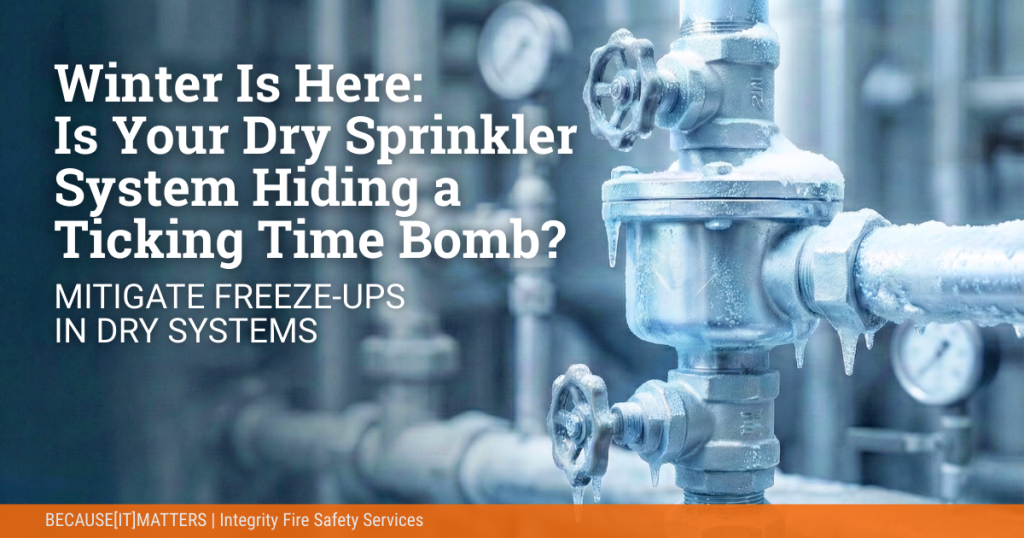
Winter Is Here: Is Your Dry Sprinkler System Holding a Ticking Time Bomb?

Drum Drips, Low-Point Drains & the Service That Mitigates Frozen Pipe Risk
The Silent Threat Inside Every Dry Sprinkler System
- Water expands by 9% when it freezes.
- That expansion can exert 30,000+ psi of pressure.
- Steel and cast-iron fittings cannot withstand that force.
What Exactly Is a Drum Drip?
A drum drip, also known as a low-point drain, is a vertical section of pipe equipped with two valves. It is intentionally placed at the lowest elevations of a dry sprinkler system.
Important Clarification:
A drum drip is the two-valve manual version designed for safe drainage while preserving system air pressure.
The Purpose of a Drum Drip:
- Capture condensation and trapped water
- Allow safe manual draining
- Prevent freezing inside branch lines
- Protect exposed piping in cold zones
- Maintain compliance with NFPA 25
Drum Drips Are Commonly Found In:
- Parking garages
- Attics
- Exterior canopies
- Loading docks
- Vestibules and entryways
- Unheated mechanical areas
- Long pipe runs with dips or pitch issues
How Drum Drips Work (and why they matter)
CRITICAL WARNING: The "Qualified Person" Requirement
STOP. Read this before anyone touches a valve.
Per NFPA 25 and Denver Fire Code, routine draining of low-point drains can be performed by facility staff only if they are deemed a “Qualified Person” who has been properly trained on the specific equipment.
Most general maintenance staff do not meet the NFPA “Qualified” standard for these specific components.
Improper draining can accidentally trip the dry valve, flooding your freezing-cold pipes with water and causing catastrophic ice breaks within minutes.
Don’t take the liability risk. If your team is not qualified, do not touch the system. Contact Integrity Fire to schedule a professional winterization service.
Proper Drum Drip Draining Sequence
(For Informational Overview Only)
- Ensure top valve is open and bottom valve is closed (Normal State).
- Close the top valve.
- Open the bottom valve to drain the condensate.
- Close the bottom valve.
- Slowly open the top valve to refill the drum.
- Repeat steps 2-5 until no water appears.
- Return to Normal State (Top Open, Bottom Closed).

Never open both valves at the same time.
- The dry valve at the riser can accidentally trip.
- Water floods into cold piping that was never meant to hold water.
The result?
- Rapid flooding
- Immediate freeze-ups
- Burst pipes
- Full-system impairment
How Often Should Drum Drips Be Drained?
- After every system operation
- Before the onset of freezing weather
- And “as needed” throughout winter
In Colorado, “as needed” has a very different meaning.
- Daily draining during sustained freezing temperatures
- Weekly draining during fall and spring temperature swings
- Professional winterization before the first hard freeze
- More frequent checks in moisture-heavy areas like:
- Parking garages
- Vestibules and entryways
- Mechanical huts
- Unheated attics
The Vulnerability No One Talks About: Entrances & Transition Zones
Why these areas struggle in winter:
- They sit between warm interior air and freezing outdoor air.
- Door cycles pull cold drafts directly across overhead piping.
- Ceiling voids are often shallow and poorly insulated.
- Long, exposed pipe runs allow water to settle.
- Rapid temperature swings accelerate condensation.
- A burst elbow or cracked fitting
- Flooding at the primary building entrance
- Electrical hazards
- Operational disruption and blocked access
The Real-World Cost of Neglect
Common consequences include:
- Burst fittings and pipe ruptures ($5,000–$50,000+ repairs)
- Flooding in garages or entrance zones
- Total dry system failure
- Tenant displacement and downtime
- Emergency response costs
- Insurance claims and deductible hits
- Accelerated corrosion from standing water
The Physics of Ice Expansion — What Actually Destroys Your Pipes
- Volume increases by ~9%
- Internal pressure exceeds 30,000 psi
- Pipe walls and fittings fail catastrophically
The Ice Plug Effect
- Temperatures rise
- The system refills
- Sprinklers activate
Your Dry System Needs More Than a Quick Check – It Needs a Winterization Service
- Draining every drum drip safely and correctly
- Verifying valve operation
- Checking system air pressure performance
- Inspecting all freeze-prone zones
- Measuring condensation load
- Identifying hidden low points
- Documenting all findings for liability protection
Winter Doesn’t Wait — Neither Should You
Schedule your Winterization Service before your year-end budget runs out.
- Schedule Service
- Learn More – Fire Sprinkler Services Explained
- Read our Fall Fire Sprinkler Prep Guide
Winter is here. Make sure your system is ready.