

Introduction: Winter Doesn’t Wait — Neither Should Your System
Every winter, dry sprinkler systems in Colorado freeze and fail—not because of design flaws, but because water was left trapped inside the pipe.
Even a teaspoon of water can freeze, expand by 9%, and create more than 30,000 psi of pressure—enough to split steel.
The single most common cause we see? Neglected Low Point Drains (aka Auxiliary Drains). If these drains aren’t checked and emptied regularly, your dry system can quickly become a freeze-and-flood emergency.
1. “Dry” Systems Are Never Truly Dry — The Condensation Problem
Dry pipe sprinkler systems are installed in cold areas—garages, attics, loading docks, exterior canopies—where temperatures cannot reliably stay above 40°F. These systems use pressurized air or nitrogen instead of water.
But “dry system” is a misleading term.
Three reasons dry systems still accumulate water:
- Condensation from Humid Air (Compressor Intake)
- Compressors draw in outside air that contains moisture. Inside cold steel piping, that moisture condenses into liquid water.
- Residual Water From Hydrostatic Testing
- After installation or repairs, systems undergo hydrostatic testing. Complete drainage is impossible—small pockets of water always remain.
- Colorado’s “Polar Coaster” Temperature Swings
- Warm days followed by sub-zero nights create constant vapor cycling and condensation inside pipe networks.
Result: Water always settles in the lowest points unless manually drained.
2. What Is a Low Point Drain (Auxiliary Drain)?
Low Point Drains—also called auxiliary drains—are required by NFPA 13 at the lowest elevations of a dry sprinkler system. Their purpose is to collect and safely discharge trapped water before it freezes.
Important distinction:
- All drum drips are low point drains.
- Not all low point drains are drum drips.
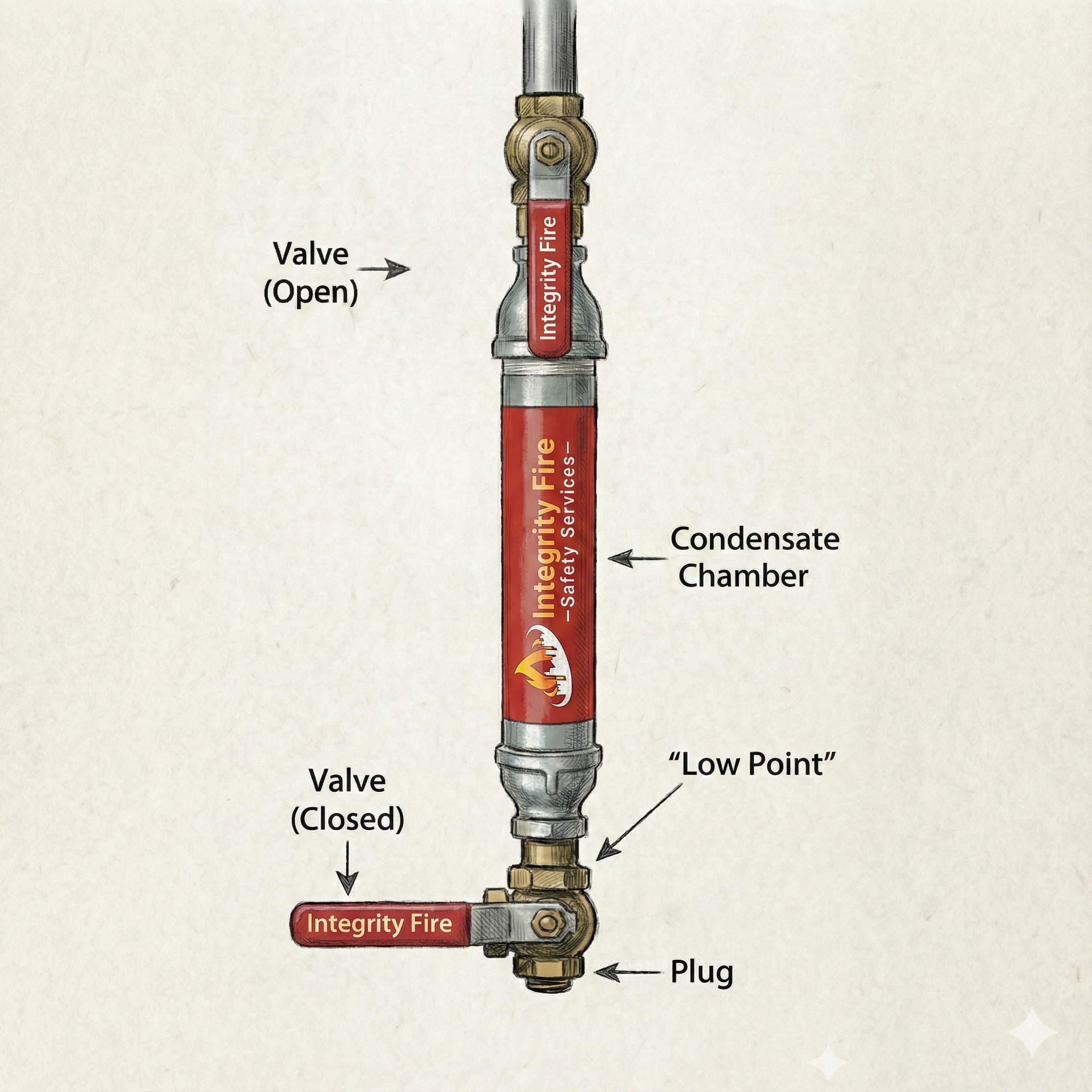
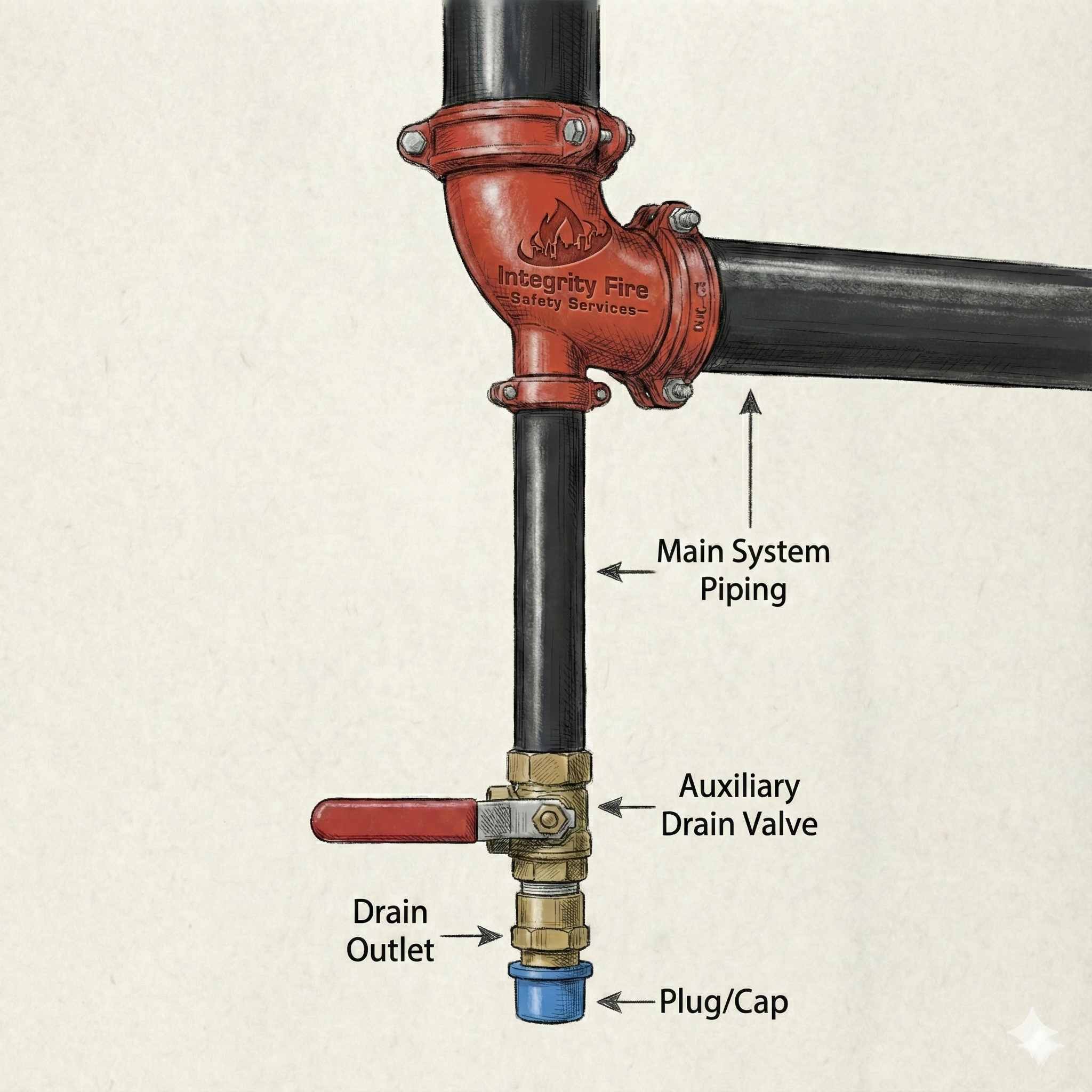
A drum drip is the most common LPD configuration—a two-valve assembly designed for controlled drainage without releasing system air pressure.
Low point drains are typically located in:
- Parking garages
- Attic spaces
- Exterior canopies
- Vestibules and entryways
- Mechanical huts
- Any area with dips, slope changes, or long horizontal runs
These drains are not optional accessories—they are essential freeze-prevention components.
3. How Low Point Drain Testing Works
During testing and maintenance, a technician confirms:
- Presence of water — indicates condensation load or drainage failure.
- Valve condition — stiff, seized, or leaking valves increase freeze risk.
- Flow rate during draining — slow flow may indicate deeper pockets of water.
- Proper pipe pitch — incorrect slope traps water upstream.
- Evidence of previous freezing — rust staining, cracked fittings, paint bubbles.
- Correct drainage sequence — critical for avoiding accidental system trips.
If both valves on a drum drip are opened simultaneously:
- System air pressure can vent rapidly.
- The dry valve may accidentally trip.
- Water may flood into exposed, freezing-cold piping.
This is one of the most common—and preventable—winter failures.
4. How Often Should Low Point Drains Be Emptied? (NFPA 25)
NFPA 25 Section 13.4.5.3.2 requires LPDs be emptied:
- After every system operation
- Before freezing weather
- And “as needed” throughout winter
The Colorado Reality
- Daily draining during extended freezing periods
- Weekly draining during fall and spring fluctuations
- More frequent draining in high-humidity areas such as:
- Vestibules and entryways
- Parking garages
- Mechanical huts
- Professional winterization before the season’s first hard freeze
Failing to follow these intervals is the #1 cause of dry system freeze-ups.
5. Entryways: The Hidden Freeze Trap
Entryways, vestibules, enclosed entrances, semi-conditioned entrances, and other unheated transition zones are among the highest-risk locations for freeze damage.
Why these areas freeze first:
- Warm interior air meets freezing exterior air.
- Door cycles pull cold drafts directly across piping.
- Shallow ceiling spaces lose heat rapidly.
- Exposed overhead low points allow water to pool.
- Rapid swings in temperature accelerate condensation.
A freeze in these areas can:
- Burst elbows or fittings
- Flood primary building entrances
- Create overhead electrical hazards
- Block tenant and customer access
- Result in costly downtime and repairs
These failures are extremely common—and completely preventable.
6. The Physics of Ice Expansion — What Actually Breaks Pipes
When water freezes:
- Volume increases by ~9%
- Pressure rises above 30,000 psi
- Steel and cast-iron fittings split open
The “Ice Plug” Effect
When a pipe ruptures during a freeze, the ice often seals the break—meaning:
- Damage is hidden
- Leaks appear only when temperatures rise
- Systems may fail when they attempt to recharge or activate
This is why freeze damage is often discovered after a cold snap.
7. Don’t Gamble with Your Dry System — Winterize Now
Low Point Drain testing protects:
- Life and property
- Building infrastructure
- System reliability
- Insurance compliance


